How to Improve Indoor Air Quality — A Complete Guide
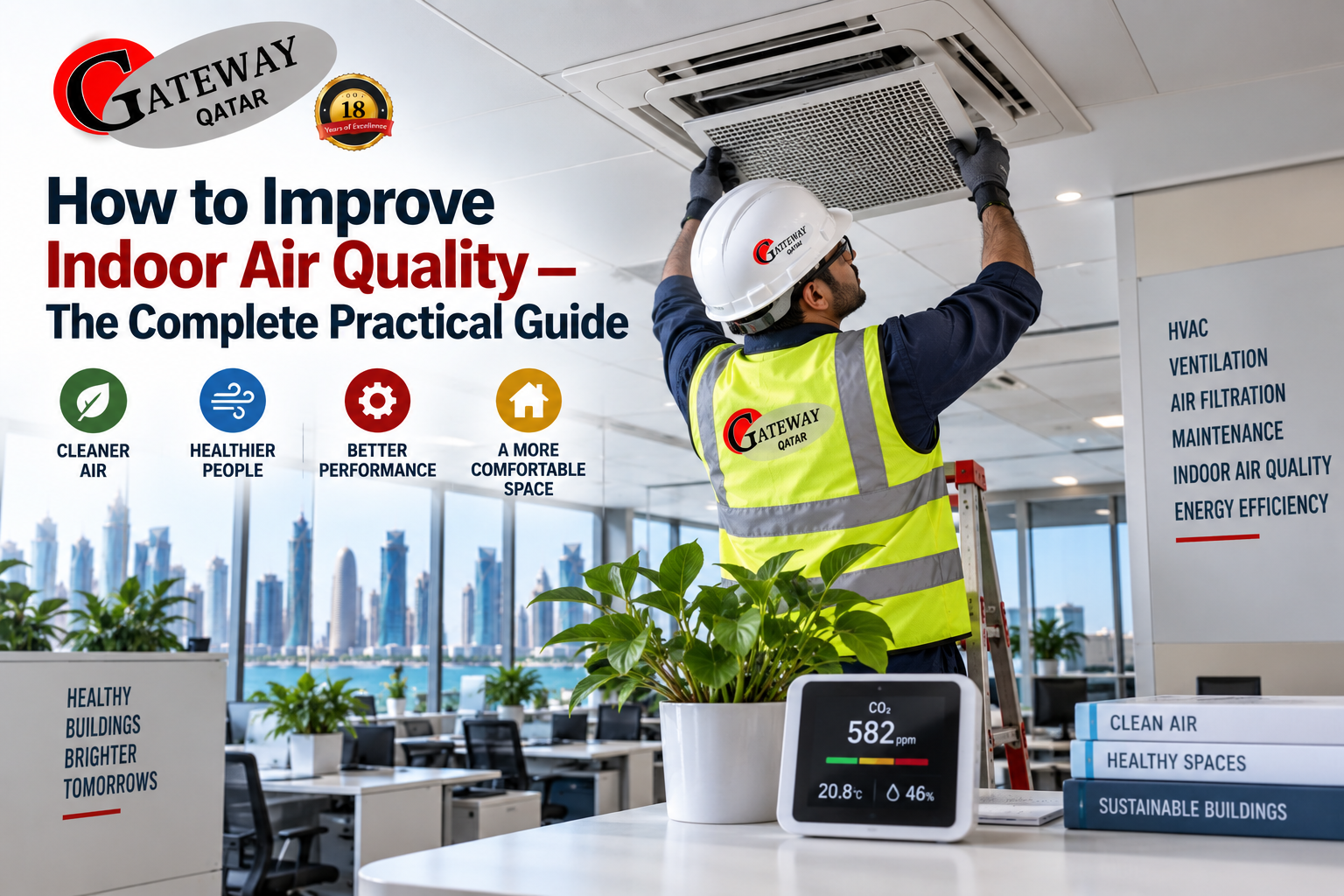
Understanding how to improve indoor air quality has become one of the most important health and comfort questions that homeowners and business owners across Qatar and globally are asking. We spend the majority of our time indoors — in homes, offices, and commercial buildings where the air quality is determined not by natural outdoor ventilation but by the design, condition, and maintenance of the building’s HVAC and ventilation systems. When those systems are working well and properly maintained, they deliver fresh, filtered, comfortable air that supports health and productivity. When they are neglected or poorly designed, they circulate dust, allergens, biological contaminants, and stale air that affects how occupants feel every hour they spend in the building.
The good news is that knowing how to improve indoor air quality does not necessarily require expensive building modifications or complex technology investments. In most residential and commercial properties, the most impactful steps on how to improve indoor air quality are achievable through correct HVAC maintenance, appropriate filtration, and better ventilation practices — actions that most property owners can implement with the help of a qualified HVAC professional and without significant capital expenditure.
This guide covers how to improve indoor air quality practically and effectively — for homes, offices, and commercial buildings where occupant health and comfort depend on getting this right.
Why Indoor Air Quality Matters More Than Most People Realise
The starting point for understanding how to improve indoor air quality is recognising why it deserves serious attention. Research consistently shows that indoor air in residential and commercial buildings can be significantly more polluted than outdoor air — a counterintuitive finding that surprises many people who associate air quality problems with outdoor pollution rather than the buildings they live and work in daily.
Indoor air pollutants accumulate from multiple sources: dust and particulates that enter through air intakes and building openings; biological contaminants including mould spores, bacteria, and dust mites that proliferate in humid, stagnant conditions; volatile organic compounds (VOCs) from furniture, cleaning products, and building materials; and carbon dioxide that builds up in poorly ventilated spaces as occupants breathe. In Qatar’s climate, where buildings are sealed tightly for energy efficiency and occupants spend most of the year relying entirely on mechanical ventilation through their HVAC systems, the quality of those systems determines almost entirely the quality of the air occupants breathe.
Understanding how to improve indoor air quality in Qatar’s specific context means understanding the HVAC system as the primary determinant of indoor air — and focusing improvement efforts there first before considering supplementary technologies.
Start With Your HVAC Filters — The Most Impactful First Step
The single most accessible and impactful step in how to improve indoor air quality for most residential and commercial properties is regular filter maintenance. HVAC filters are the primary barrier between the outdoor air drawn into the building — carrying dust, pollen, and particulates from Qatar’s environment — and the indoor air that occupants breathe. A clean, correctly specified filter captures these contaminants effectively. A dirty, blocked, or inadequately rated filter allows them to pass through and circulate throughout the building.
How to improve indoor air quality through filter maintenance involves two dimensions — frequency and specification. In Qatar’s dusty environment, where sandstorm events can dramatically increase particulate loading in a matter of hours, HVAC filters accumulate contamination significantly faster than in cleaner environments. Cleaning or replacing filters every 4-6 weeks during Qatar’s heavy summer usage period — rather than the once or twice per year that might be adequate in a more moderate climate — is the single most cost-effective step in how to improve indoor air quality for most Qatar properties.
Filter specification matters equally. Standard fibreglass filters capture large particles but allow fine particulates, allergens, and biological contaminants to pass through. Higher-efficiency pleated filters with a MERV rating of 8-13 capture a significantly greater proportion of fine particles — improving indoor air quality measurably without restricting airflow excessively. For properties where occupants have respiratory sensitivities, upgrading filter specification as part of how to improve indoor air quality delivers immediate, perceptible improvements in the air people breathe.
Coil Cleaning — The Hidden Key to How to Improve Indoor Air Quality
One of the least visible but most important aspects of how to improve indoor air quality in any building with a mechanical air conditioning system is the condition of the evaporator coil inside the indoor unit. The evaporator coil is the surface over which every cubic metre of air in the building circulates continuously — and a coil surface contaminated with dust, biological growth, mould, and debris is actively degrading the quality of the air passing over it regardless of how clean the filters in the system may be.
Professional evaporator coil cleaning — carried out as part of scheduled HVAC maintenance — is one of the most effective steps in how to improve indoor air quality that most property owners overlook entirely. Clean coils not only improve air quality directly by removing the contamination that would otherwise be entrained into the airstream — they also improve the dehumidification performance of the system, reducing the moisture levels that encourage biological growth throughout the building’s air distribution system.
For residential properties where family health is a priority, and for commercial properties where occupant productivity and wellbeing directly affect business performance, scheduling professional coil cleaning at least twice per year is an essential element of any serious programme on how to improve indoor air quality. Our guide on AC servicing in Qatar explains exactly what professional coil cleaning involves and why it should be part of every HVAC maintenance visit.
Ventilation — Bringing Fresh Air Into the Indoor Environment
How to improve indoor air quality through ventilation addresses the fundamental need for fresh outdoor air to dilute the CO₂, VOCs, and other contaminants that accumulate in occupied buildings over time. In Qatar’s climate, where opening windows for natural ventilation is impractical for many months of the year due to extreme heat, humidity, and dust, mechanical ventilation through the HVAC system is the primary means through which fresh air reaches building occupants.
Many residential properties in Qatar are ventilated entirely through their split AC systems — which recirculate indoor air rather than introducing fresh outdoor air. This recirculation-only approach maintains comfortable temperatures but does nothing to dilute indoor contaminants, making CO₂ and VOC accumulation a genuine air quality concern in tightly sealed, heavily occupied spaces.
How to improve indoor air quality in these properties involves either introducing a dedicated fresh air supply through the HVAC design — using a fresh air handling unit or heat recovery ventilation system to deliver filtered outdoor air without the energy penalty of bringing in unconditioned air — or ensuring that existing HVAC systems are operated with their fresh air dampers open at appropriate times. A qualified HVAC engineer can assess the ventilation arrangements of any property and recommend practical improvements on how to improve indoor air quality through better fresh air management.
Humidity Control — The Environmental Factor That Amplifies Everything Else
Humidity control is a dimension of how to improve indoor air quality that is frequently overlooked in discussions focused primarily on filtration and ventilation. Indoor relative humidity levels above 60% create conditions that actively promote mould growth, dust mite proliferation, and bacterial activity — all of which significantly degrade indoor air quality regardless of how well the filtration and ventilation systems are performing.
In Qatar’s coastal areas, achieving and maintaining correct indoor humidity levels through the air conditioning system is a genuine challenge — particularly in buildings with high occupancy or significant moisture sources like commercial kitchens, swimming pools, or extensive indoor planting. How to improve indoor air quality through humidity management involves ensuring the HVAC system is correctly designed and maintained to provide adequate dehumidification, and considering dedicated dehumidification equipment in spaces where the standard HVAC system cannot maintain target humidity levels under peak loading.
According to the American Society of Heating, Refrigerating and Air-Conditioning Engineers (ASHRAE), maintaining indoor relative humidity between 30-60% is one of the most important environmental standards for healthy indoor air quality — directly confirming that humidity management is a critical component of any comprehensive programme on how to improve indoor air quality.
For guidance on how professional HVAC maintenance supports humidity control and how it contributes to overall improvements in indoor air quality, our guide on HVAC maintenance Qatar covers the maintenance standards that address every air quality determinant the HVAC system influences.
Gateway Qatar — Supporting Better Indoor Air Quality Across Qatar Since 2004
Gateway Qatar W.L.L helps residential and commercial property owners across Qatar improve indoor air quality through professional HVAC installation, maintenance, and system optimisation. From filter specification upgrades and professional coil cleaning through fresh air ventilation design and humidity management, our qualified HVAC engineers provide the practical expertise that every property needs to deliver genuinely healthy, comfortable indoor air for its occupants.
📞 Call: +974 44370415
📞 WhatsApp: +974 55750173
🌐 Our Services: gatewayqatarqa.com/hvac
📋 Free Quote: Contact us today
Frequently Asked Questions
What is the most effective step in how to improve indoor air quality?
The most effective and immediately accessible step in how to improve indoor air quality in most residential and commercial properties is regular HVAC filter maintenance — cleaning or replacing filters every 4-6 weeks during heavy usage periods in Qatar’s dusty environment. Combined with annual professional coil cleaning and refrigerant verification, these HVAC maintenance steps deliver the most significant and sustainable improvements in indoor air quality for the majority of Qatar properties.
Does my AC system affect indoor air quality?
Yes — significantly. In Qatar’s climate where buildings are sealed for energy efficiency and occupants rely entirely on mechanical air conditioning for ventilation, the HVAC system is the primary determinant of indoor air quality. A well-maintained system with clean filters and coils delivers filtered, dehumidified air that supports healthy indoor conditions. A poorly maintained system circulates dust, biological contaminants, and stale air that progressively degrades the air quality occupants experience.
How does professional coil cleaning improve indoor air quality?
Professional evaporator coil cleaning removes the accumulated dust, mould, and biological contamination from the coil surface over which all indoor air circulates. This prevents contaminated air from being distributed throughout the building, improves the system’s dehumidification performance, and reduces the biological growth that thrives on contaminated coil surfaces and degrades indoor air quality over time.
Can Gateway Qatar advise on how to improve indoor air quality in commercial buildings?
Yes — Gateway Qatar’s qualified HVAC engineers assess the ventilation, filtration, and humidity management arrangements of commercial buildings and recommend practical improvements on how to improve indoor air quality tailored to the specific building type, occupancy, and HVAC system. Contact us on +974 44370415 to arrange an assessment for your commercial property.
Does Gateway Qatar provide indoor air quality improvement services across all of Qatar?
Yes — Gateway Qatar provides HVAC services supporting indoor air quality improvement across the whole of Qatar including Doha, Ar-Rayyan, Lusail, West Bay, Al Wakrah, Al Khor, Umm Salal, Al Daayen, and all surrounding areas. Contact us on +974 44370415 for expert advice on how to improve indoor air quality in your property.