What Is Laser Shaft Alignment? 6 Powerful Facts to Know
What is laser shaft alignment is a question that comes up repeatedly in maintenance engineering circles — and it deserves a thorough, practical answer because the technology behind it, and the outcomes it delivers, are significantly more impactful than most property owners and facility managers appreciate until they have experienced the difference between a machine that has been properly aligned using laser technology and one that has been approximately aligned using traditional methods.
Laser shaft alignment is the precision process of measuring and correcting the angular and parallel misalignment between two coupled rotating shafts — a motor shaft and a pump shaft, a motor shaft and a fan shaft, or any other coupled rotating equipment — using laser measurement technology that is accurate to thousandths of a millimetre. Understanding what is laser shaft alignment means understanding both the technology behind it and the specific equipment reliability and energy efficiency benefits it delivers — benefits that have made laser shaft alignment the professional standard for rotating equipment maintenance in industrial and commercial facilities worldwide.
Gateway Technologies — the dedicated Motor Rewinding and Pump Repair Division of Gateway Qatar, providing professional laser shaft alignment services across Qatar since 2004 — explains the six most powerful facts that answer what is laser shaft alignment comprehensively and practically.
Fact 1: What Is Laser Shaft Alignment — The Technology Explained
The starting point for understanding what is laser shaft alignment is understanding the technology itself — specifically how a laser alignment system measures shaft misalignment and why that measurement is so significantly more accurate than traditional methods.
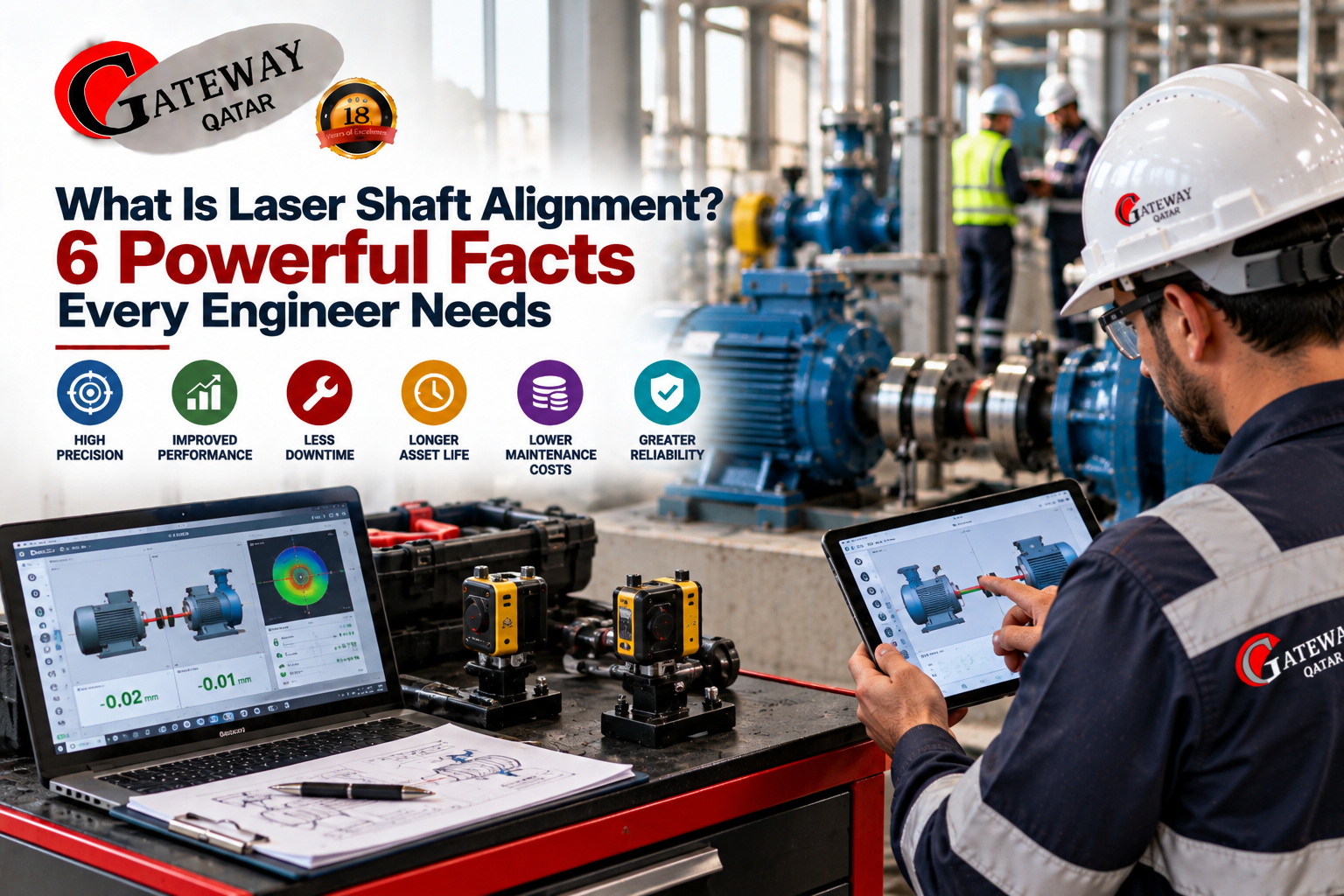
A laser shaft alignment system consists of two precision units — a laser transmitter and a laser receiver — each magnetically clamped to one of the two shafts being aligned. When the machine is slowly rotated, the laser beam sweeps across the receiver face, and the receiver measures the exact position of the laser beam at multiple rotational positions around the shaft. These measurements are fed into an alignment calculator — either a dedicated display unit or a connected tablet — which uses them to compute the exact angular and parallel misalignment between the two shafts in both the horizontal and vertical planes simultaneously.
What is laser shaft alignment’s key technical advantage over dial gauge methods is that the laser measurement is immune to the mechanical variables — bracket sag, dial gauge runout, and feeler gauge thickness variation — that introduce interpretation errors into traditional alignment readings. The laser measures what is actually happening at the shaft faces rather than what the measuring tool’s mechanical limitations allow it to approximate — producing numerical alignment values that are objective, repeatable, and documented.
Fact 2: The Two Types of Misalignment That Laser Shaft Alignment Measures
A critical component of understanding what is laser shaft alignment is understanding the two distinct types of shaft misalignment that it measures and corrects — because both types cause damage by different mechanisms and both must be corrected for the alignment to be complete.
Angular misalignment is the condition where the centrelines of the two coupled shafts meet at an angle rather than being collinear — like two pencils pointing at each other at a slight angle rather than perfectly end to end. Angular misalignment generates alternating bending loads on bearings and coupling elements with every shaft rotation, and the rate at which these loads cause fatigue damage increases with the degree of angular misalignment and the rotational speed of the machine.
Parallel misalignment — also called offset misalignment — is the condition where the centrelines of the two coupled shafts are parallel but displaced from each other in the horizontal or vertical plane, or both. Parallel misalignment generates radial loads on bearings that are constant in magnitude but rotating in direction with every shaft revolution, creating a bearing loading environment that significantly accelerates rolling element fatigue.
What is laser shaft alignment’s practical significance is that it measures both types simultaneously — in both the horizontal and vertical planes — and calculates the exact combination of shim changes and lateral moves required to correct both types of misalignment in a single adjustment procedure, rather than the iterative trial-and-error approach that traditional methods require.
Fact 3: What Is Laser Shaft Alignment Tolerances — How Precise Is Precise Enough?
Understanding what is laser shaft alignment tolerances is important for maintenance engineers specifying alignment work — because what constitutes an acceptable residual misalignment after correction depends on the type of coupling being used and the rotational speed of the machine, and these variables determine how tightly the alignment must be held to achieve the maximum bearing and seal life that precision alignment delivers.
As a general reference, modern flexible couplings operating at 1500-3000 RPM (typical pump and motor speeds in Qatar’s industrial and commercial applications) typically require angular misalignment to be corrected to within 0.05-0.10 mm/100mm and parallel offset to within 0.05-0.10 mm — tolerances that laser alignment achieves routinely but that traditional dial gauge methods struggle to verify reliably.
What is laser shaft alignment’s advantage in this context is that the laser system displays the measured residual misalignment in real time as corrections are being made — allowing the engineer to verify that the correction has been achieved within the specified tolerance before the machine is reassembled and restarted, rather than discovering that the tolerance was not achieved only when the machine’s performance fails to improve as expected after reassembly.
For guidance on how alignment tolerances interact with bearing life and seal performance in Qatar’s specific operating context, our guides on laser shaft alignment Qatar and shaft alignment service Qatar cover the practical implications in detail.
Fact 4: What Is Laser Shaft Alignment’s Impact on Energy Consumption?
What is laser shaft alignment’s energy consumption impact is a dimension that is often overlooked in discussions focused primarily on bearing and seal life — but it is financially significant and has been documented consistently across industries and facility types.
Misaligned rotating machinery requires the drive motor to develop additional torque to overcome the resistance generated by misalignment forces at the coupling and bearings — additional torque that translates directly into additional current draw and therefore additional electricity consumption above the rated load requirement of the machine. Correcting this misalignment through what is laser shaft alignment eliminates the additional mechanical resistance and reduces motor current draw back toward the rated value — delivering an immediate and ongoing electricity saving with every operating hour following the alignment correction.
The magnitude of this saving varies with the degree of misalignment corrected — more severely misaligned machines deliver larger energy savings — but even modest misalignment corrections consistently produce measurable current reductions in the 2-5% range, which across a facility with many continuously operating machines in Qatar’s year-round operating environment accumulates into a financially meaningful annual electricity cost reduction.
According to the American Society of Civil Engineers (ASCE), precision alignment programmes consistently deliver measurable energy consumption reductions alongside reliability improvements — confirming that what is laser shaft alignment is simultaneously a reliability investment and an energy management tool.
Fact 5: When Should What Is Laser Shaft Alignment Be Performed?
Understanding what is laser shaft alignment includes understanding when it should be performed — because many facilities limit alignment work to new installations when it should be a routine maintenance activity applied at multiple trigger points throughout the machine’s operational life.
What is laser shaft alignment’s most important application points include every new machine installation or reinstallation following maintenance; after every bearing replacement on either the driver or driven machine; after any motor or pump replacement; after any maintenance work that requires the machine to be lifted or moved on its baseplate; after periods of significant thermal cycling that can cause baseplate distortion; and as a scheduled preventative maintenance activity on critical machines — typically annually for continuously operating equipment.
Each of these trigger points represents an opportunity for misalignment to have been introduced or to have changed from its previously measured value — making what is laser shaft alignment at these points not a luxury but a standard maintenance step that protects the investment made in the bearing and seal replacements or new equipment that preceded it.
Fact 6: What Is Laser Shaft Alignment’s Documentation Advantage
The sixth powerful fact about what is laser shaft alignment is the documentation advantage it provides over traditional alignment methods — and the practical maintenance management value that documentation delivers for facilities managing multiple rotating machines across complex operational environments.
Every modern laser alignment system produces a detailed alignment report showing the initial misalignment values found, the correction moves applied in sequence, the final residual misalignment values achieved, and the comparison of both sets of values against the coupling-specific tolerance table for the machine’s operating speed. This report is an objective, numerical, permanent record of what was found and what was done — verifiable by any subsequent engineer who needs to understand the alignment history of the machine.
What is laser shaft alignment’s documentation advantage is particularly valuable in Qatar’s industrial and commercial facilities where rotating equipment is maintained over long operational periods by multiple service teams. The alignment history produced by laser alignment reports allows trends to be identified — machines that repeatedly misalign after every maintenance intervention may have foundation, pipework, or thermal growth issues that require investigation beyond routine alignment correction — and baseline values to be compared across multiple maintenance cycles to track alignment stability over time.
According to the Qatar Chamber of Commerce, engaging qualified engineering contractors with proper documentation practices for specialist services including what is laser shaft alignment is essential for protecting equipment investment and operational reliability across Qatar’s commercial and industrial sectors.
Gateway Technologies — Laser Shaft Alignment Expertise Across Qatar
Gateway Technologies answers the practical question of what is laser shaft alignment through professional laser alignment services for every type of coupled rotating equipment across Qatar’s industrial, commercial, and building services sectors. Our documented laser alignment reports, calibrated equipment, and experienced technicians deliver the precision and accountability that what is laser shaft alignment genuinely requires to deliver its full reliability and efficiency benefits.
📞 WhatsApp: 557 50173
✉️ Email: [email protected] / [email protected]
📋 Free Quote: Contact Gateway Qatar today
📍 Workshop: Opposite Aspire Park, Mauither, Qatar
Frequently Asked Questions
What is laser shaft alignment in simple terms?
What is laser shaft alignment in simple terms is the precision process of measuring how far two coupled rotating shafts — a motor and a pump, for example — are out of line with each other, and correcting that misalignment using laser measurement technology accurate to thousandths of a millimetre. The result is a machine whose rotating components are running in their designed positions, generating minimum vibration, minimum bearing load, and minimum energy consumption.
What is laser shaft alignment’s main advantage over dial gauge alignment?
What is laser shaft alignment’s main advantage is precision and objectivity. Laser systems measure misalignment to thousandths of a millimetre without the mechanical variables — bracket sag and gauge runout — that limit dial gauge accuracy. The laser system also measures angular and parallel misalignment in both planes simultaneously and calculates the exact correction required, eliminating the iterative trial-and-error adjustment that traditional methods require.
What is laser shaft alignment’s impact on bearing life?
What is laser shaft alignment’s impact on bearing life is substantial — correctly aligned machines experience none of the additional bearing loads that misalignment generates, allowing bearings to achieve their full rated operational life. Facilities that implement regular laser alignment programmes consistently report significant reductions in bearing replacement frequency compared to their pre-alignment maintenance histories.
What is laser shaft alignment’s role in an overall preventative maintenance programme?
What is laser shaft alignment plays a central role in any comprehensive rotating equipment preventative maintenance programme — alongside motor insulation resistance testing, vibration monitoring, lubrication management, and mechanical seal inspection. Together these activities address every primary failure mechanism in rotating machinery, preventing the unplanned breakdowns that reactive maintenance programmes accept as inevitable.
Does Gateway Technologies explain and apply what is laser shaft alignment across all of Qatar?
Yes — Gateway Technologies provides professional laser shaft alignment services across the whole of Qatar including Doha, Ar-Rayyan, Lusail, Al Wakrah, Al Khor, Mesaieed Industrial City, and all surrounding areas. Contact us via WhatsApp on 557 50173 for expert laser shaft alignment service anywhere in Qatar.