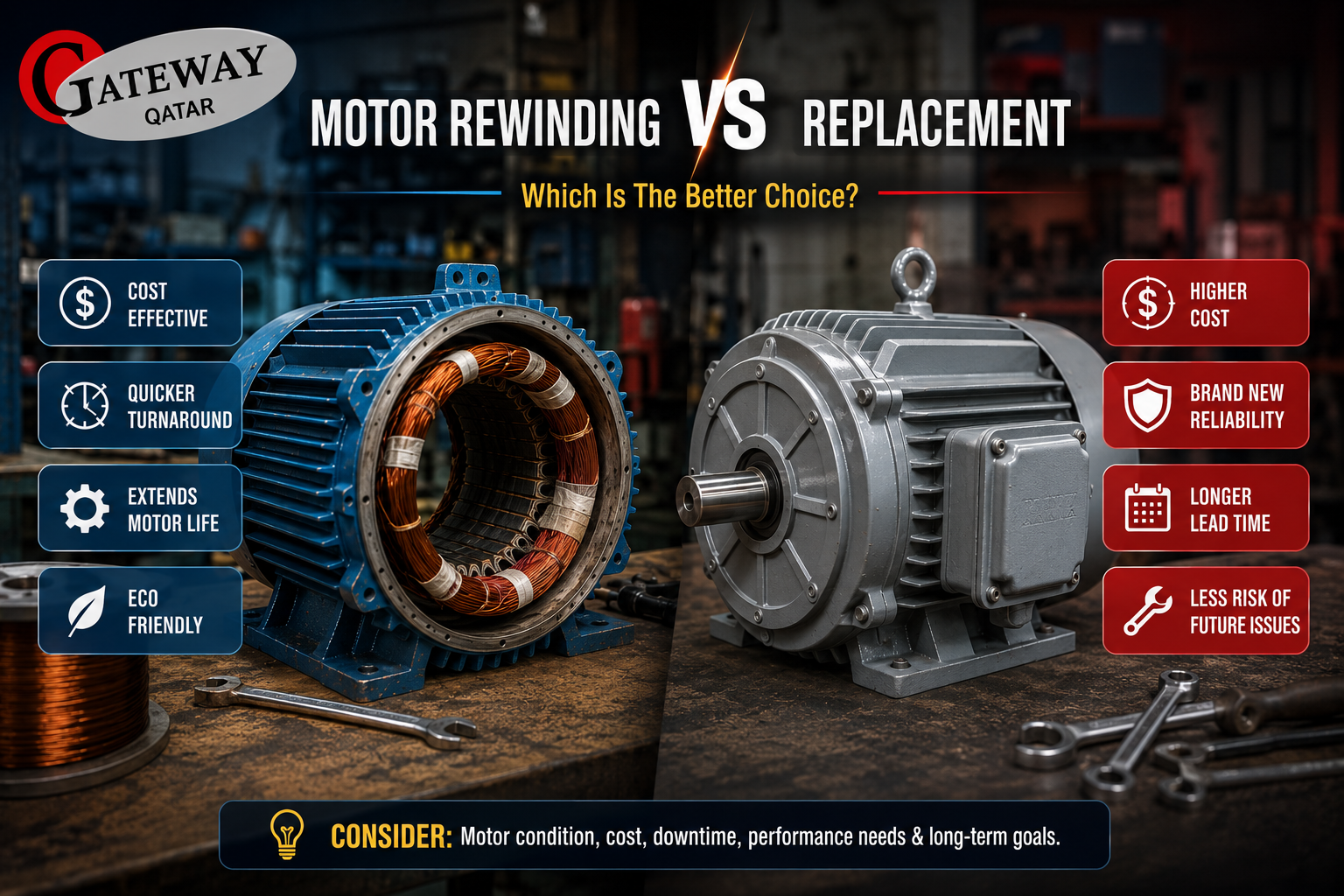
Motor Rewinding vs Replacement: Which Is the Better Choice?
The motor rewinding vs replacement decision is one of the most common and consequential choices any facility manager, maintenance engineer, or operations director faces when an electric motor fails. Get it right and you restore full operational capability at the lowest possible cost and the fastest possible turnaround. Get it wrong and you either spend far more than necessary on a replacement you did not need, or you invest in a rewind that cannot deliver the reliability or efficiency improvements that a new motor would have provided.
The motor rewinding vs replacement debate has no single universal answer — the right choice depends on a combination of factors specific to each motor, each application, and each operating environment. However, there are clear, objective principles that guide the motor rewinding vs replacement decision in the vast majority of real-world situations — principles that experienced motor engineering workshops apply every day to help their clients make the most financially sound and operationally appropriate choice for every motor failure they encounter.
Gateway Technologies — the dedicated Motor Rewinding and Pump Repair Division of Gateway Qatar, providing expert motor services across Doha and the whole of Qatar since 2004 — breaks down the motor rewinding vs replacement decision so that every facility manager and maintenance engineer can make the right call with confidence.
Understanding the Core Motor Rewinding vs Replacement Question
Before diving into the specific factors, it is important to understand what the motor rewinding vs replacement decision actually involves. Motor rewinding restores a failed motor to its original performance specification by replacing the failed winding coils with new precision-wound coils using quality-grade materials — addressing the root cause of the failure while preserving the motor’s original mechanical components, frame, and core. Motor replacement involves procuring a complete new motor of equivalent specification and installing it in place of the failed unit.
Both paths can restore operational capability — the motor rewinding vs replacement question is which one does so more effectively, more quickly, and at lower total cost for the specific situation at hand.
Factor 1: Cost — The Primary Driver of the Motor Rewinding vs Replacement Decision
Cost is almost always the first consideration in the motor rewinding vs replacement evaluation, and in the majority of cases it is also the most conclusive. Professional motor rewinding typically costs 40-60% less than purchasing an equivalent new motor of the same specification, frame size, and voltage rating — a cost advantage that alone makes rewinding the preferred choice in most situations where the motor’s mechanical components are in sound condition.
The cost advantage of rewinding in the motor rewinding vs replacement analysis widens significantly for:
- Larger motors above 15kW — the absolute cost difference between rewinding and replacement grows substantially as motor size increases, making the financial case for rewinding increasingly compelling for larger industrial motors
- Specialist or non-standard motors — motors with unusual voltage ratings, frame configurations, duty classifications, or performance specifications frequently carry significant replacement cost premiums, making rewinding the financially obvious choice in the motor rewinding vs replacement evaluation
- Imported or long-lead-time motors — when replacement requires importing a motor from an overseas manufacturer with a 4-12 week lead time, the cost of operational downtime during that waiting period can dwarf the difference in component cost between rewinding and replacement, decisively resolving the motor rewinding vs replacement question in favour of rewinding
For facility managers in Doha and across Qatar — where many specialist industrial motors are imported from Europe or Asia with extended lead times — the combination of lower rewinding cost and significantly faster turnaround frequently makes the motor rewinding vs replacement decision straightforward. For more on how our rewinding process restores motors to full specification, read our guide on motor winding service in Qatar.
Factor 2: Motor Age and Condition — The Technical Dimension of Motor Rewinding vs Replacement
Motor age and overall mechanical condition are the second major factor in the motor rewinding vs replacement evaluation. A motor’s mechanical components — the stator core, rotor, frame, end shields, and shaft — have a significantly longer service life than the winding insulation, provided they have not been subjected to mechanical damage or severe environmental deterioration. A motor with a sound stator core, undamaged rotor, and serviceable mechanical components is an excellent candidate for rewinding in the motor rewinding vs replacement analysis, even if it has been in service for many years.
Key condition factors that inform the motor rewinding vs replacement decision include:
- Stator core condition — a qualified rewinding workshop will test the stator core for lamination damage or hot spots before proceeding with rewinding. A core that passes testing provides the foundation for a fully restored rewound motor — in this case, motor rewinding vs replacement clearly favours rewinding. A core with significant lamination damage may not support effective rewinding, shifting the motor rewinding vs replacement decision toward replacement
- Rotor condition — a sound rotor with no evidence of casting defects, broken bars, or mechanical damage is compatible with rewinding in the motor rewinding vs replacement evaluation. Significant rotor damage may require either rotor repair — adding cost to the rewind — or full motor replacement
- Frame and mechanical integrity — a motor frame that has been subjected to severe corrosion, mechanical impact damage, or chemical attack may not justify rewinding in the motor rewinding vs replacement analysis if the frame condition will limit the operational life of the rewound motor
Factor 3: Energy Efficiency — The Long-Term Financial Dimension of Motor Rewinding vs Replacement
The energy efficiency dimension of the motor rewinding vs replacement decision is one of the most frequently debated aspects of the topic — and one of the most commonly misunderstood. The concern is whether rewinding a motor reduces its energy efficiency compared to its original specification, making a high-efficiency replacement motor the more financially attractive choice over its operational lifetime despite the higher initial cost.
The evidence on this aspect of motor rewinding vs replacement is clear when rewinding is carried out correctly by a qualified workshop using proper materials and processes:
- Professional rewinding preserves original efficiency — motor rewinding carried out to the correct specification using quality-grade copper wire, correct slot fill, proper insulation, and vacuum pressure impregnation consistently preserves the original motor efficiency within 1-2% of the as-manufactured value. In the motor rewinding vs replacement evaluation, this means that a professionally rewound motor imposes no meaningful energy efficiency penalty compared to the failed original
- Premium efficiency replacement motor advantage — the motor rewinding vs replacement decision does favour replacement when the failed motor is a significantly older design with a low original efficiency rating and a modern premium efficiency motor of the same specification is available at a reasonable cost premium. In this scenario, the energy savings from the higher efficiency replacement motor can justify the additional cost over the operational life of the installation
- Qatar operating context — in Qatar’s high-duty environment where motors run year-round, even small efficiency improvements translate into meaningful electricity bill savings over time. The motor rewinding vs replacement decision should therefore include an honest calculation of the payback period for any efficiency premium paid for a replacement motor
According to the American Society of Civil Engineers (ASCE), lifecycle cost analysis — incorporating both upfront repair or replacement cost and ongoing energy cost — consistently produces better maintenance investment decisions than upfront cost comparison alone, directly confirming that the motor rewinding vs replacement decision benefits from considering long-term running costs alongside the immediate repair expense.
Factor 4: Availability and Lead Time — The Operational Urgency Dimension of Motor Rewinding vs Replacement
The fourth major factor in the motor rewinding vs replacement decision is operational urgency — specifically, how quickly each option can restore the failed motor to service and eliminate the production loss, comfort impact, or safety risk that the failure is causing.
In the motor rewinding vs replacement analysis for urgent situations:
- Local rewinding turnaround — a professional rewinding workshop with proper equipment and adequate staffing can typically complete motor rewinding for a standard motor within 5-10 working days from receipt of the motor. For critical applications, priority processing can reduce this further. In Doha and across Qatar, Gateway Technologies provides exactly this fast-turnaround service
- Replacement procurement lead time — replacing a motor requires either holding a spare in stock — a cost that many facilities choose not to carry for every motor on site — or sourcing a replacement from a local distributor or overseas manufacturer. For common motor types, local distributor stock may allow same-day or next-day replacement. For specialist motors, overseas procurement can take 4-12 weeks or more, making rewinding the only operationally viable option in the motor rewinding vs replacement analysis
- The 50% rule as a practical guide — a widely used practical guideline for the motor rewinding vs replacement decision states that if the cost of rewinding exceeds 50% of the cost of an equivalent new replacement motor, replacement should be seriously considered. If rewinding costs less than 50% of replacement, rewinding is generally the preferred choice. This rule provides a useful starting framework for the motor rewinding vs replacement evaluation, though the other factors discussed in this article should always be considered alongside it
For guidance on the warning signs that a motor is approaching failure — and therefore the motor rewinding vs replacement decision — before complete breakdown occurs, our detailed guide on signs your electric motor needs rewinding covers every indicator that maintenance teams should monitor.
When Motor Replacement Clearly Wins the Motor Rewinding vs Replacement Decision
While rewinding is the preferred choice in the majority of situations, there are specific circumstances where the motor rewinding vs replacement analysis clearly favours replacement:
- Severe mechanical damage — motors that have suffered catastrophic mechanical failure — shaft fracture, severe rotor damage, or badly corroded frames — where the cost of mechanical repair compounds the rewinding cost to approach or exceed replacement cost
- Very small low-voltage motors — for small motors below approximately 2-5kW, the labour cost of rewinding can approach or exceed the cost of a standard replacement motor, shifting the motor rewinding vs replacement decision toward replacement on straightforward cost grounds
- Obsolete motor types — motors of obsolete design where replacement with a modern equivalent delivers meaningful efficiency, reliability, or maintainability improvements that justify the replacement premium in the motor rewinding vs replacement evaluation
- Motors at end of mechanical life — motors with bearing housings worn beyond economical repair, corroded frames, or cracked end shields where the mechanical structure cannot reliably support a rewound motor for a further meaningful service period
Gateway Technologies — Your Motor Rewinding vs Replacement Advisor in Qatar
At Gateway Technologies in Doha, we provide honest, objective motor rewinding vs replacement assessments for every motor that comes through our workshop — giving facility managers and maintenance engineers the information they need to make the right decision, not the decision that maximises our workshop revenue. When rewinding is the right answer, we rewind to the highest quality standard using quality-grade copper winding materials, proper insulation and varnishing, and comprehensive electrical testing. When replacement is genuinely the better option, we say so clearly.
Our motor rewinding vs replacement assessment service for clients across Qatar includes:
- ✅ Complete motor disassembly and component condition assessment
- ✅ Stator core loss testing to verify core suitability for rewinding
- ✅ Rotor inspection and mechanical condition evaluation
- ✅ Honest written assessment and recommendation on motor rewinding vs replacement
- ✅ Competitive rewinding quotation where rewinding is recommended
- ✅ Service across Doha and the whole of Qatar
Contact Gateway Technologies for Motor Rewinding vs Replacement Assessment
Not sure whether rewinding or replacement is the right choice for your failed motor? Contact Gateway Technologies today for an honest, expert motor rewinding vs replacement assessment anywhere across Qatar.
📞 WhatsApp: 557 50173
✉️ Email: [email protected] / [email protected]
📋 Get a Free Quote: Contact Gateway Qatar today
📍 Workshop: Opposite Aspire Park, Mauither, Doha, Qatar
Frequently Asked Questions
Is motor rewinding vs replacement always a cost decision?
Cost is the primary factor but not the only one. Motor age, mechanical condition, stator core integrity, operational urgency, lead time for replacement, and the availability of a higher-efficiency replacement motor all contribute to the motor rewinding vs replacement decision. Gateway Technologies provides a complete assessment covering all of these factors for every motor we evaluate
Does rewinding reduce motor efficiency compared to a new motor?
Professional rewinding carried out with quality-grade copper wire, correct slot fill, and proper vacuum pressure impregnation preserves the original motor efficiency within 1-2% — imposing no meaningful efficiency penalty in the motor rewinding vs replacement evaluation. Only where a significantly more efficient modern replacement motor is available at a reasonable cost premium does replacement offer a genuine long-term energy cost advantage
What is the 50% rule in motor rewinding vs replacement?
The 50% rule states that if rewinding costs less than 50% of the cost of an equivalent new replacement motor, rewinding is generally the preferred choice. If rewinding costs approach or exceed 50% of replacement cost, replacement should be seriously considered. This rule provides a useful starting framework but should always be evaluated alongside motor age, condition, lead time, and efficiency considerations.
How long does professional motor rewinding take?
Standard motor rewinding at Gateway Technologies typically takes 5-10 working days including comprehensive electrical testing. Priority processing is available for critical applications. Contact us via WhatsApp on 557 50173 for an accurate turnaround estimate for your specific motor.
Does Gateway Technologies provide motor rewinding vs replacement assessments across all of Qatar?
Yes. Gateway Technologies provides motor rewinding vs replacement assessment and rewinding services across the whole of Qatar including Doha, Ar-Rayyan, Al Wakrah, Al Khor, Mesaieed, and all surrounding areas. Contact us via WhatsApp on 557 50173 to discuss your motor situation today.