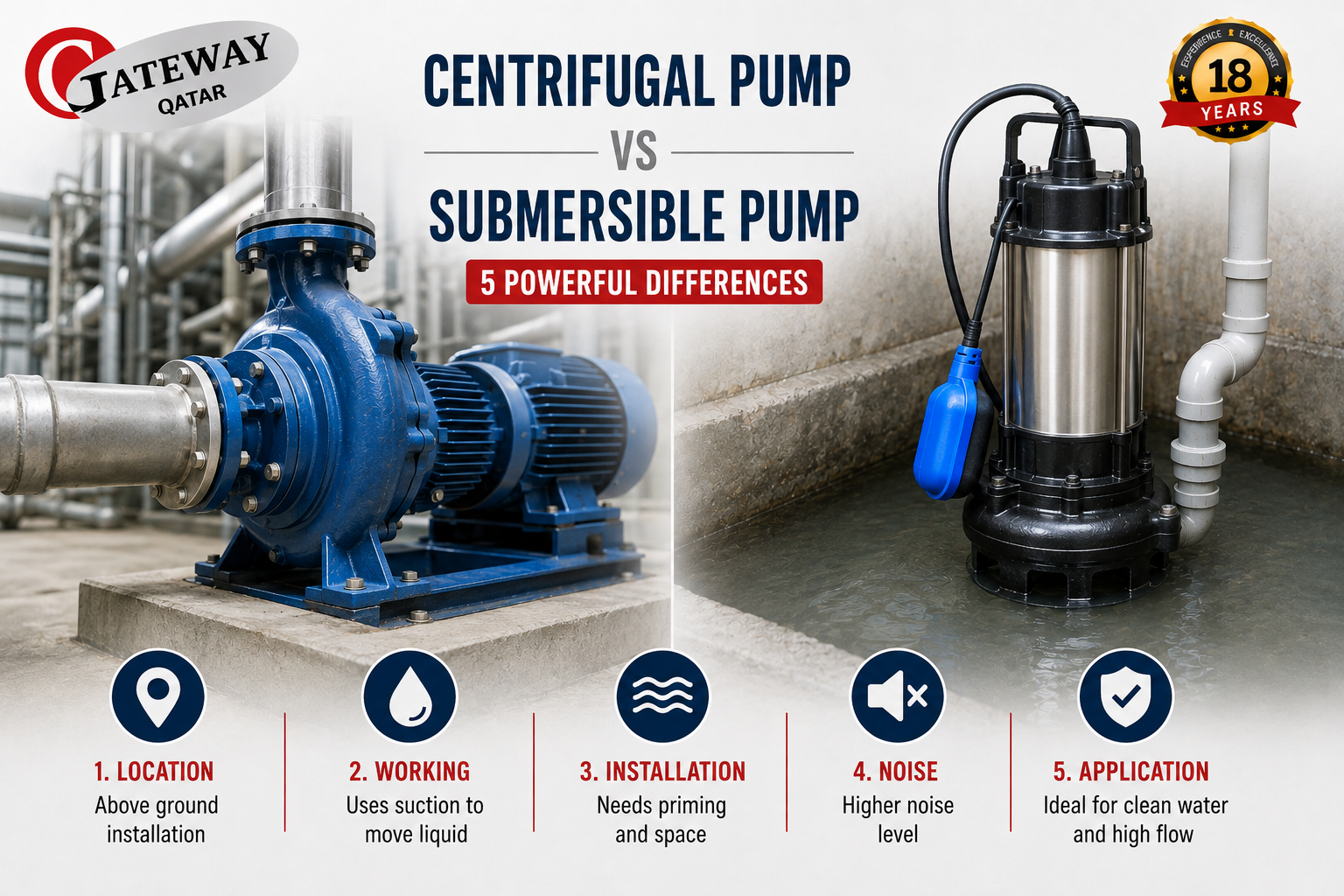
Centrifugal Pump vs Submersible Pump: 5 Powerful Differences
The centrifugal pump vs submersible pump comparison is one of the most fundamental selection decisions in any water supply, drainage, or industrial process application — and making the right choice between these two pump types has direct consequences for system performance, installation cost, maintenance requirements, and long-term operational reliability. Both centrifugal pumps and submersible pumps are widely used across Qatar’s residential, commercial, and industrial sectors, and both have specific application strengths that make each the clearly superior choice in certain situations.
Understanding the centrifugal pump vs submersible pump differences at a practical, engineering level — rather than simply at a specification sheet level — gives facility managers, project engineers, and building services professionals the knowledge they need to specify the right pump type for every application they encounter. Getting the centrifugal pump vs submersible pump decision right from the outset avoids the operational problems, energy inefficiency, and maintenance complications that inevitably follow when the wrong pump type is selected for an application it was never designed to serve well.
Gateway Technologies — providing expert pump repair, overhauling, and maintenance services for both centrifugal and submersible pumps across Doha and Qatar since 2004 — breaks down the 5 most powerful differences in the centrifugal pump vs submersible pump comparison so you can make the right selection for every application.
Difference 1: Installation Location and Configuration
The first and most fundamental difference in the centrifugal pump vs submersible pump comparison is where each pump type is installed relative to the fluid being pumped — because this installation location difference drives every other difference in the centrifugal pump vs submersible pump evaluation.
Centrifugal pumps are surface-mounted units installed above the fluid level they are pumping from. The pump and motor assembly sits in a dry, accessible location — a plant room, pump house, or mechanical services area — with suction pipework drawing fluid from the source below and discharge pipework directing it to the destination. This above-ground installation makes centrifugal pumps fully accessible for inspection, maintenance, and repair without any requirement to remove the pump from its installation position.
Submersible pumps are designed to operate fully immersed in the fluid they are pumping — installed below the fluid surface in wells, boreholes, sumps, tanks, or wet pits. The motor and pump are sealed as a single waterproof assembly that must withstand continuous submersion in the pumped fluid. This below-surface installation means submersible pumps are not directly accessible during operation and must be retrieved from their installation position for inspection, maintenance, and repair.
In the centrifugal pump vs submersible pump installation comparison, the accessibility advantage of centrifugal pumps — enabling routine maintenance without removal from the installation — is a significant practical benefit that reduces maintenance cost and complexity compared to submersible pumps that must be retrieved for every service intervention.
For guidance on the maintenance implications of each pump type in Qatar’s operating environment, our guide on pump maintenance Qatar covers the specific maintenance requirements that the centrifugal pump vs submersible pump installation difference creates.
Difference 2: Application Suitability
The second powerful difference in the centrifugal pump vs submersible pump comparison is application suitability — the specific pumping scenarios where each type delivers superior performance, reliability, and value.
Centrifugal pumps are most suitable for:
- Above-ground water supply and distribution — boosting water pressure from storage tanks to building distribution systems is one of the most common centrifugal pump applications across Qatar’s commercial and residential buildings
- HVAC chilled water and condenser water circulation — centrifugal pumps are the standard choice for HVAC hydronic systems in Qatar’s commercial buildings, hotels, and industrial facilities
- Industrial process fluid transfer — process cooling water, chemical transfer, and general industrial fluid circulation applications across Qatar’s industrial sector
- Fire fighting systems — fire fighting pumps are almost universally centrifugal pump designs, delivering the high flow rates at moderate pressure that fire suppression systems require
Submersible pumps are most suitable for:
- Borehole and groundwater abstraction — submersible pumps are the only practical option for abstracting water from deep boreholes and wells where the water table is significantly below surface level
- Drainage and wastewater removal — submersible pumps installed in drainage sumps, sewage collection pits, and basement drainage systems handle the removal of wastewater from below-grade areas
- Irrigation from underground sources — villa and compound irrigation systems drawing from underground storage or borehole sources commonly use submersible pumps as part of the water supply arrangement
- Dewatering on construction sites — submersible pumps are widely used for temporary dewatering of excavations on Qatar’s construction sites
In the centrifugal pump vs submersible pump application comparison, the key principle is matching the pump installation configuration to the physical arrangement of the source and destination — if the source is below ground and must be pumped upward from a submerged position, submersible wins. If the source can be accessed from above ground level, centrifugal is almost always the preferred choice.
Difference 3: Maintenance Requirements and Accessibility
The third powerful difference in the centrifugal pump vs submersible pump comparison is maintenance requirements — both the frequency and complexity of maintenance that each pump type demands to remain operating reliably.
Centrifugal pump maintenance is relatively straightforward because the pump is fully accessible in its installed position. Bearing inspection and lubrication, mechanical seal condition assessment, impeller inspection, coupling alignment verification, and motor electrical testing can all be performed with the pump in situ. Centrifugal pump maintenance can be carried out more frequently and at lower cost per visit than equivalent submersible pump maintenance precisely because of this accessibility advantage.
Submersible pump maintenance requires retrieval of the pump from its installation position before any inspection or maintenance work can be carried out — adding the time, labour, and equipment cost of extraction and reinstallation to every maintenance intervention. In deep borehole applications, extraction requires specialist lifting equipment that adds further cost and complexity to the maintenance process.
In the centrifugal pump vs submersible pump maintenance comparison, centrifugal pumps generally require lower total maintenance cost over their operational life — though submersible pumps with correctly specified sealing and motor protection can operate for extended periods between interventions when the application conditions are well matched to the pump design.
For guidance on what professional maintenance involves for both pump types and how to structure maintenance programmes that maximise reliability across both, our guide on pump repair vs replacement provides useful context for the lifecycle cost dimension of the centrifugal pump vs submersible pump comparison.
Difference 4: Motor Protection and Reliability in Demanding Environments
The fourth powerful difference in the centrifugal pump vs submersible pump comparison is motor protection and reliability — particularly relevant in Qatar’s demanding operating environment where extreme heat, humidity, and continuous duty cycles place exceptional stress on pump drive motors.
Centrifugal pump motors are standard air-cooled electric motors installed in dry, accessible locations. They can be specified with a wide range of enclosure protection ratings, cooling arrangements, and insulation classes appropriate for the specific installation environment. When centrifugal pump motors fail in Qatar’s environment — through winding insulation breakdown caused by extreme heat, moisture ingress, or continuous overload — they can be rewound at a specialist motor winding workshop like Gateway Technologies with straightforward access. Our detailed guide on centrifugal pump repair in Qatar covers the repair process for this pump type in detail.
Submersible pump motors are hermetically sealed, fluid-cooled motors that rely on the pumped fluid for motor cooling — making them sensitive to dry running conditions where the motor is energised without fluid surrounding it. Submersible pump motor failure in Qatar’s applications — particularly in borehole and irrigation applications where low water levels can cause dry running — requires specialist repair that addresses both the motor winding failure and the watertight sealing system that is unique to submersible pump design. Our guide on submersible pump repair in Qatar explains the specific repair requirements of this pump type.
In the centrifugal pump vs submersible pump motor reliability comparison, centrifugal pump motors are generally more robust against the environmental stresses of Qatar’s operating conditions — and simpler and less expensive to repair when failure does occur.
Difference 5: Cost — Purchase, Installation, and Lifetime
The fifth and final powerful difference in the centrifugal pump vs submersible pump comparison is total cost — covering purchase price, installation cost, and the lifetime maintenance and repair costs that together determine the true financial investment each pump type represents over its operational life.
Centrifugal pump cost profile:
- Purchase price — generally comparable to submersible pumps of equivalent flow and head specification, though specific configurations vary
- Installation cost — centrifugal pumps require surface mounting, suction and discharge pipework, and motor electrical connection in a dry accessible location. Installation cost is typically moderate and does not require specialist equipment
- Lifetime maintenance cost — lower than submersible pumps due to accessibility, with motor repair and mechanical service straightforward and cost-effective at a standard pump repair workshop
Submersible pump cost profile:
- Purchase price — generally comparable to centrifugal pumps of equivalent specification, though deep well submersible pumps with stainless steel construction can carry significant premiums
- Installation cost — borehole and deep well submersible pump installation requires specialist equipment for lowering and retrieving the pump assembly, adding to installation cost compared to surface-mounted centrifugal options
- Lifetime maintenance cost — higher than centrifugal pumps due to extraction requirements for every maintenance intervention, with submersible motor repair requiring specialist sealing expertise beyond standard motor rewinding capability
In the centrifugal pump vs submersible pump total cost comparison, centrifugal pumps typically deliver lower total lifetime cost for above-ground applications where both pump types could theoretically be used — while submersible pumps are indispensable and therefore cost-competitive by necessity for borehole, deep drainage, and below-grade applications where no practical centrifugal alternative exists.
According to the American Society of Civil Engineers (ASCE), lifecycle cost analysis incorporating purchase, installation, maintenance, and energy costs consistently produces better pump selection decisions than upfront purchase price comparison alone — directly confirming that the centrifugal pump vs submersible pump decision should evaluate total cost of ownership rather than simply capital cost.
According to the Qatar Chamber of Commerce, engaging qualified engineering contractors for pump selection, installation, and maintenance is essential to ensure optimal pump performance and equipment longevity across Qatar’s commercial and industrial applications.
Gateway Technologies — Expert in Both Centrifugal and Submersible Pump Repair
Gateway Technologies provides professional repair, overhauling, and maintenance services for both centrifugal pumps and submersible pumps — across every application type in Qatar’s residential, commercial, and industrial sectors. Whether your facility requires centrifugal pump repair following impeller wear or mechanical seal failure, or submersible pump repair following winding burnout or seal system failure from dry running, our dedicated workshop and skilled technicians deliver comprehensive, quality-controlled pump repair for both types.
Our centrifugal pump vs submersible pump repair capabilities include:
- ✅ Centrifugal pump mechanical overhaul — impeller, seal, bearing, alignment
- ✅ Submersible pump repair — motor rewinding, seal restoration, pressure testing
- ✅ Drive motor rewinding for both pump types
- ✅ Performance testing after every repair
- ✅ Written test reports and maintenance documentation
- ✅ Service across Doha and the whole of Qatar
Contact Gateway Technologies
Need expert pump repair or maintenance for centrifugal or submersible pumps? Contact Gateway Technologies today for honest, professional service anywhere across Qatar.
📞 WhatsApp: 557 50173
✉️ Email: [email protected] / [email protected]
📋 Get a Free Quote: Contact Gateway Qatar today
📍 Workshop: Opposite Aspire Park, Mauither, Doha, Qatar
Frequently Asked Questions
Which is better — a centrifugal pump or a submersible pump?
Neither is universally better — the centrifugal pump vs submersible pump decision depends entirely on the specific application. Centrifugal pumps are better for above-ground installations in plant rooms and accessible locations where maintenance accessibility and motor reliability are priorities. Submersible pumps are the only practical option for borehole abstraction, deep drainage, and below-grade fluid removal applications. Gateway Technologies can advise on the right choice for any specific application.
Which pump type is easier to maintain in Qatar’s climate?
Centrifugal pumps are generally easier and less expensive to maintain in Qatar’s climate because they are surface-mounted and fully accessible in their installed position, allowing bearing inspection, seal service, and motor testing without any extraction from the installation. Submersible pumps require retrieval from their installation position for every maintenance intervention, adding cost and complexity to each service visit.
Can Gateway Technologies repair both centrifugal and submersible pumps?
Yes — Gateway Technologies provides professional repair and overhauling services for both centrifugal pumps and submersible pumps across all sizes and applications. Our workshop covers mechanical overhaul, motor rewinding, seal replacement, and performance testing for both pump types, serving clients across Doha and the whole of Qatar.
What causes submersible pump motor failure in Qatar?
The most common causes of submersible pump motor failure in Qatar are dry running damage when water levels drop below the pump intake — a common problem in borehole and tank-fed systems during high demand periods — moisture ingress through deteriorated motor seals, and winding insulation breakdown caused by elevated operating temperatures from Qatar’s extreme ambient conditions.
Does Gateway Technologies provide pump services across all of Qatar?
Yes — Gateway Technologies provides pump repair, overhauling, and maintenance services across the whole of Qatar including Doha, Ar-Rayyan, Al Wakrah, Al Khor, Mesaieed Industrial City, and all surrounding areas. Contact us via WhatsApp on 557 50173 to discuss pump services for your facility anywhere in Qatar.