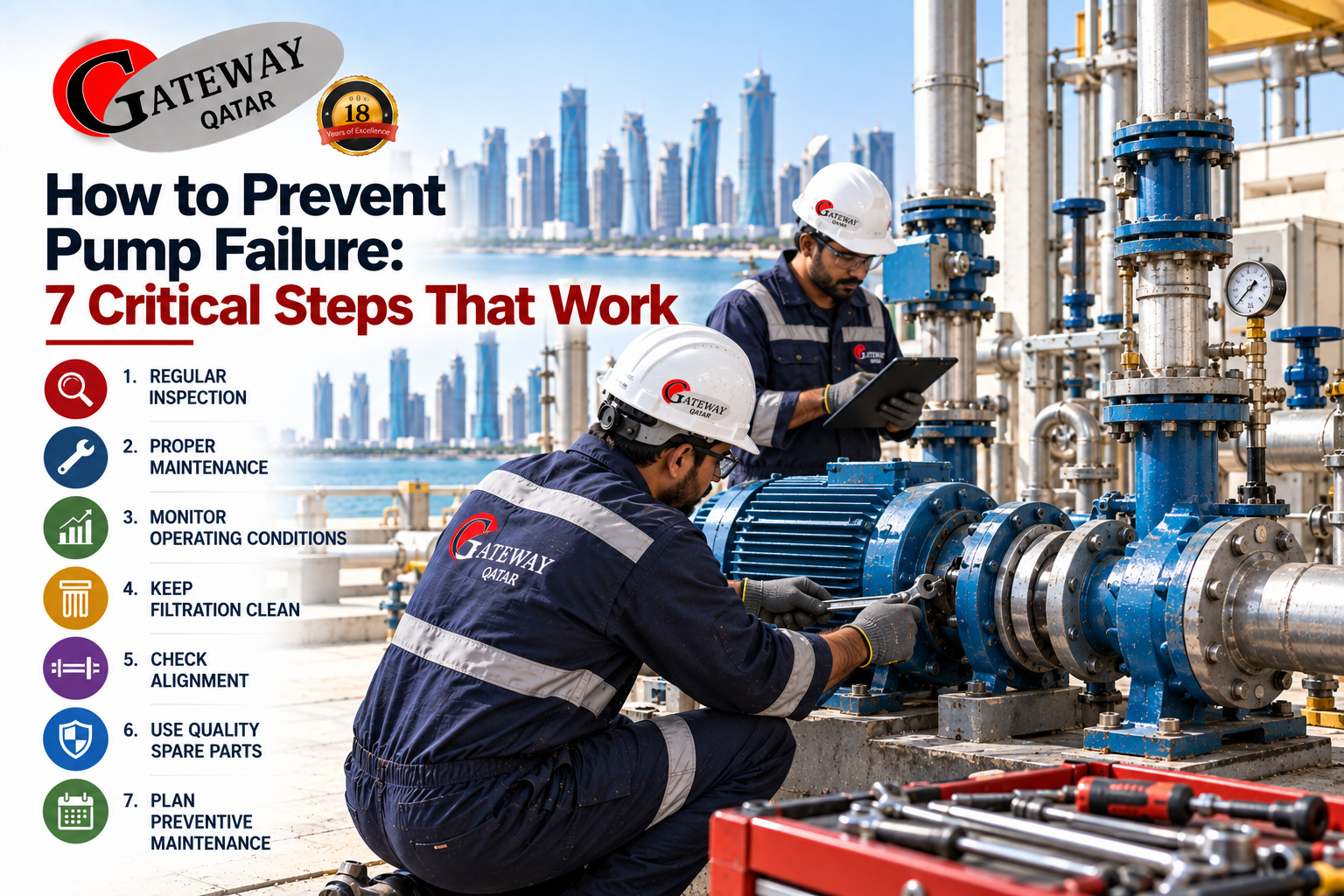
How to Prevent Pump Failure: 7 Critical Steps That Work
Understanding how to prevent pump failure is one of the most financially valuable pieces of operational knowledge any facility manager, maintenance engineer, or industrial operations director can possess. Pump failures are rarely sudden, catastrophic events — they are almost always the end point of a progressive deterioration process that began weeks or months earlier and generated warning signals at every stage. The challenge is that in facilities where reactive maintenance dominates, those warning signals go unread until the pump stops, the production line halts, the water supply fails, or the HVAC system loses flow — at which point how to prevent pump failure becomes a post-mortem rather than a forward-looking discipline.
The financial case for learning how to prevent pump failure is compelling and direct. Emergency pump repair costs more than planned repair because it demands immediate response, priority workshop processing, and often faster shipping of components. Operational downtime has a cost that compounds every hour the pump is out of service. Secondary damage — to motor windings, shaft seals, couplings, and connected pipework — caused by allowing a developing fault to run to complete failure almost always exceeds the cost of the primary repair. Facilities that invest seriously in how to prevent pump failure consistently spend less on pump maintenance over any meaningful comparison period than those that do not.
Gateway Technologies — providing professional pump maintenance, repair, and motor rewinding services across Qatar since 2004 — shares seven critical steps that form the practical foundation of any effective programme on how to prevent pump failure.
Step 1: Monitor Performance Continuously — Not Just at Service Visits
The most powerful starting point in how to prevent pump failure is establishing baseline performance measurements for every pump in the facility and tracking those measurements consistently over time. Flow rate, discharge pressure, suction pressure, and motor operating current together paint a comprehensive picture of pump health — and changes in any of these values relative to the established baseline are early indicators that something is developing inside the pump that maintenance should investigate.
How to prevent pump failure through performance monitoring does not require sophisticated instrumentation for most applications. A simple pressure gauge on the discharge line, a clamp meter on the motor supply cable, and a flow measurement from the system flow meter taken at regular, consistent operating conditions provide all the data needed to detect the gradual performance decline that precedes most pump failures. The key is consistency — taking measurements at the same operating point at defined intervals and comparing them to the baseline rather than treating each reading as a standalone observation.
Step 2: Inspect and Replace Mechanical Seals Proactively
One of the most impactful practical steps in how to prevent pump failure is treating mechanical seal replacement as a planned maintenance activity rather than a reactive repair triggered by visible leakage. Mechanical seal failure is one of the most common primary causes of pump breakdown — and in demanding operating environments where high temperatures, chemical exposure, or abrasive fluids accelerate seal wear, the traditional approach of waiting for leakage before replacing seals is one of the most reliably preventable causes of unplanned downtime.
How to prevent pump failure through proactive seal management involves establishing a seal replacement interval based on the specific operating conditions of each pump — the fluid being pumped, the operating temperature, the shaft speed, and the continuous versus intermittent nature of operation — and replacing seals on schedule regardless of their apparent condition. The cost of a planned seal replacement is a small fraction of the repair cost that follows when a failed seal allows fluid to contaminate the bearing housing, corrode the shaft, and ultimately cause bearing failure alongside the seal damage.
Step 3: Address Shaft Alignment — The Silent Killer
Shaft misalignment is one of the most consistently underestimated contributors to pump bearing and seal failure — and addressing it systematically is one of the highest-impact steps available in how to prevent pump failure across any pump-dependent facility. When the pump shaft and motor shaft are misaligned — even by fractions of a millimetre beyond acceptable tolerance — the rotating assembly generates radial and axial bearing loads that dramatically accelerate bearing fatigue and cause mechanical seal face wear that reduces seal life independently of the fluid and temperature conditions.
How to prevent pump failure from misalignment-driven bearing and seal deterioration requires precision alignment verification at every major maintenance intervention — and laser alignment rather than dial gauge methods for applications where operating speeds and coupling types demand tighter tolerances. The investment in precision alignment is modest and the return — in extended bearing life, reduced seal replacement frequency, and lower overall pump maintenance costs — is consistently among the highest of any single maintenance action in how to prevent pump failure programmes.
Step 4: Test Motor Winding Insulation Regularly
A dimension of how to prevent pump failure that many maintenance programmes overlook entirely is the condition of the drive motor’s winding insulation — because pump and motor failures are frequently concurrent or sequential, and a pump whose mechanical components are in acceptable condition but whose motor winding insulation has deteriorated to a borderline level is a system heading for failure through a different path than the one currently being monitored.
How to prevent pump failure through motor condition monitoring involves periodic insulation resistance testing of pump drive motors using a calibrated megohmmeter — a quick, non-invasive test that provides an objective numerical indicator of winding insulation health. Motors with declining insulation resistance trend identified through regular testing can be scheduled for rewinding during a planned maintenance window rather than failing unexpectedly mid-operation. For detailed guidance on what insulation resistance values indicate and when they signal the need for rewinding, our guide on signs your electric motor needs rewinding provides the complete reference framework.
Step 5: Keep Pump Bearings Correctly Lubricated
Bearing failure accounts for a substantial proportion of all pump failures in industrial and commercial service — and the majority of those bearing failures are directly attributable to incorrect or neglected lubrication rather than any intrinsic deficiency in the bearing or pump design. How to prevent pump failure through correct lubrication requires attention to three distinct variables: the correct grease type and grade for the bearing specification and operating conditions, the correct lubrication quantity applied at each interval, and the correct lubrication interval calibrated for the actual operating temperature and duty cycle of the pump.
Over-lubrication is as damaging as under-lubrication in this context — excess grease churns into heat, raises bearing operating temperature, and can contaminate motor windings. How to prevent pump failure through lubrication therefore means following manufacturer specifications precisely rather than applying a “more is better” approach that is one of the most common lubrication errors in practical pump maintenance.
Step 6: Act on Vibration and Noise Changes Immediately
One of the most actionable and most frequently deferred steps in how to prevent pump failure is responding immediately to any change in vibration level or operational noise from a pump rather than monitoring it for a few more weeks to see if it gets worse. The practical reality is that abnormal vibration and noise are not early warnings that provide infinite time to act — they are middle-stage failure indicators that mark the beginning of an accelerated deterioration phase where the rate of damage is significantly higher than the preceding normal operation period.
How to prevent pump failure from escalating once vibration or noise changes appear means investigating the cause promptly — distinguishing between bearing deterioration, impeller imbalance, cavitation, misalignment, and loosening mechanical components — and carrying out the identified corrective action before the secondary damage that continued operation with an identified fault causes compounds the original repair scope significantly.
According to the American Society of Civil Engineers (ASCE), condition-based maintenance programmes that respond promptly to early fault indicators consistently deliver 15-25% lower total lifecycle maintenance costs compared to reactive approaches — directly confirming that how to prevent pump failure through prompt fault response is the financially superior maintenance strategy across all pump-dependent facilities.
Step 7: Plan Major Pump Maintenance Around Operations — Not Around Breakdowns
The seventh and most strategically important step in how to prevent pump failure is shifting major pump maintenance — seal replacement, bearing replacement, impeller inspection, and motor rewinding assessment — from reactive interventions triggered by failure to planned activities scheduled around the operational calendar of the facility.
How to prevent pump failure through planned maintenance means identifying the operating periods when pump downtime has the lowest operational impact — planned shutdowns, low-production periods, building closure periods — and using these windows for the proactive maintenance that prevents the unplanned failures that would otherwise occur during the most operationally critical periods. A fire fighting pump whose seals and bearings are replaced during a planned quarterly maintenance visit causes no operational disruption. The same pump failing its annual activation test or failing during an actual emergency creates consequences no amount of subsequent repair can undo.
According to the Qatar Chamber of Commerce, engaging properly licensed and qualified engineering contractors for planned pump maintenance programmes is essential for protecting operational reliability and equipment investment across Qatar’s commercial and industrial sectors.
For guidance on how proactive pump maintenance and the decision between pump repair and overhaul work together in practice, our guides on pump maintenance Qatar and pump repair vs replacement cover the complete operational maintenance framework.
Gateway Technologies — Helping You Prevent Pump Failure Across Qatar
Gateway Technologies provides the complete range of pump maintenance, repair, overhauling, and motor rewinding services that support every step of how to prevent pump failure across industrial, commercial, and building services facilities throughout Qatar. From performance monitoring support and planned seal and bearing replacement through motor insulation testing and proactive rewinding, our dedicated workshop and skilled field team give every facility manager the professional support their how to prevent pump failure programme needs.
📞 WhatsApp: 557 50173
✉️ Email: [email protected] / [email protected]
📋 Free Quote: Contact Gateway Qatar today
📍 Workshop: Opposite Aspire Park, Mauither, Qatar
Frequently Asked Questions
What is the most common cause of pump failure?
Bearing failure and mechanical seal deterioration are the two most common primary causes of pump failure in industrial and commercial service. Both are preventable through the steps described in this guide on how to prevent pump failure — particularly correct lubrication, proactive seal replacement scheduling, and shaft alignment verification at every major maintenance intervention.
How does motor condition affect how to prevent pump failure?
The pump drive motor’s winding insulation condition is directly connected to how to prevent pump failure — a motor with deteriorating insulation will fail and stop the pump regardless of how good the pump’s mechanical components are. Including regular motor insulation resistance testing in any how to prevent pump failure programme provides the early warning that allows motor rewinding to be planned rather than reacted to.
Can performance monitoring really help prevent pump failure?
Yes — consistently tracking discharge pressure, flow rate, and motor current against established baselines is one of the most powerful steps in how to prevent pump failure available without significant capital investment. Most pump failures produce measurable performance changes weeks before complete breakdown — monitoring catches these changes when corrective action is still inexpensive and minimally disruptive.
How does shaft alignment contribute to how to prevent pump failure?
Shaft misalignment generates bearing loads and seal face wear forces that dramatically accelerate both bearing and seal deterioration — making precision alignment verification at every major maintenance visit one of the highest-return actions in any how to prevent pump failure programme. Laser alignment verification costs relatively little and the bearing life extension it delivers is substantial and directly measurable.
Does Gateway Technologies provide pump failure prevention services across all of Qatar?
Yes — Gateway Technologies provides pump maintenance, motor condition testing, seal and bearing replacement, and motor rewinding services that support how to prevent pump failure across the whole of Qatar including Doha, Ar-Rayyan, Lusail, Al Wakrah, Al Khor, Mesaieed Industrial City, and all surrounding areas. Contact us via WhatsApp on 557 50173 to discuss a pump failure prevention programme for your facility today.