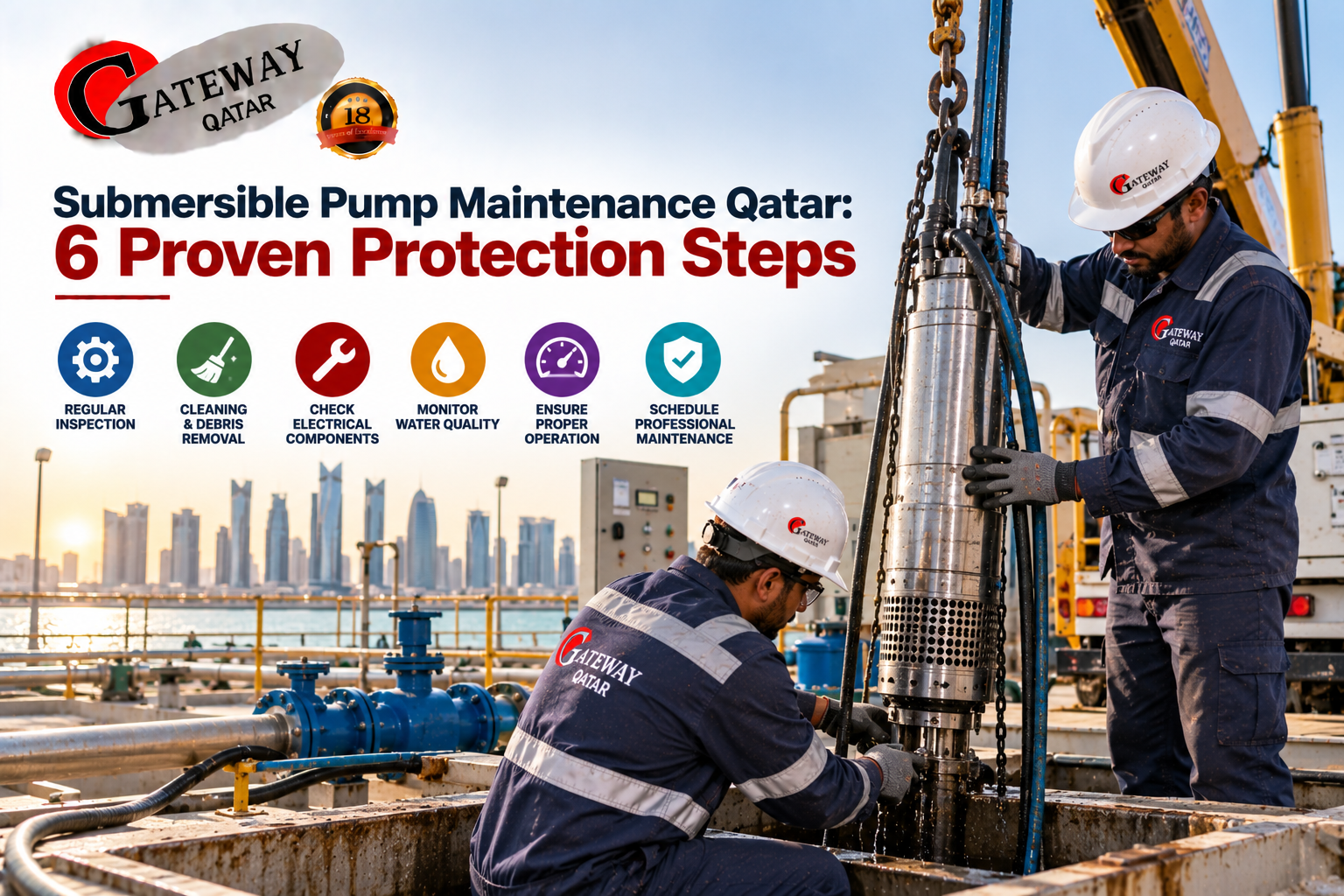
Submersible Pump Maintenance Qatar: 6 Proven Protection Steps
Submersible pump maintenance Qatar is one of the most frequently neglected yet most operationally critical maintenance activities across the country’s residential, commercial, and agricultural sectors. Submersible pumps operate in an inherently challenging environment — fully immersed in the fluid they are pumping, inaccessible during operation, and exposed to the specific quality characteristics of Qatar’s groundwater and storage water that accelerate internal corrosion and wear at rates that surface-mounted pump operators rarely encounter. When submersible pump maintenance is inadequate or absent, the consequences range from gradual performance deterioration through to complete pump failure that leaves buildings without water supply, irrigation systems offline, and drainage systems overwhelmed.
What makes submersible pump maintenance uniquely demanding compared to maintenance of surface-mounted equipment is the extraction requirement — every maintenance intervention requires removing the pump from its installation position, whether that is a borehole, storage tank, drainage sump, or wet pit. This extraction adds time, labour, and in deep borehole applications specialist lifting equipment to every submersible pump maintenance visit, making the cost per visit higher than equivalent surface pump maintenance and creating a natural incentive to defer maintenance that experienced facility managers resist because they understand the far higher cost of reactive repair following complete failure.
Gateway Technologies — providing professional submersible pump maintenance for residential, commercial, and infrastructure clients since 2004 — shares six proven protection steps that every facility manager must follow to maximise submersible pump operational life and avoid the disruption of unplanned failure.
Step 1: Establish the Right Submersible Pump Maintenance Qatar Frequency
The foundation of effective submersible pump maintenance is establishing the correct service frequency for each pump in the facility — calibrated to its specific duty cycle, application type, and the quality characteristics of the fluid it is pumping rather than defaulting to a generic annual interval that may be adequate for some applications but dangerously insufficient for others.
For borehole and groundwater submersible pumps in Qatar’s geological conditions, a minimum twelve-monthly submersible pump maintenance Qatar inspection — with extraction, full condition assessment, and motor electrical testing — is the professional baseline. For drainage and sewage submersible pumps handling aggressive fluids that accelerate seal and impeller wear, six-monthly submersible pump maintenance visits are more appropriate given the harsher operating environment. For irrigation submersible pumps that operate seasonally in Qatar’s agricultural and landscaping sector, a comprehensive submersible pump maintenance Qatar inspection at the beginning and end of each heavy usage period is the standard that protects pumps through their highest-demand operational phases.
Step 2: Always Include Motor Insulation Testing in Submersible Pump Maintenance Qatar
The most impactful electrical check in any submersible pump maintenance programme is insulation resistance testing of the submersible motor — a test that provides the clearest available objective indicator of whether the motor’s watertight sealing system remains intact and whether the winding insulation has maintained its dielectric integrity since the previous inspection.
Submersible motors depend entirely on their mechanical seal system to keep the pumped fluid from contacting the motor windings. In Qatar’s operating conditions — where temperature cycling, chemical exposure, and the mechanical stresses of operation progressively challenge every sealing interface — even motors that appear externally undamaged can have moisture ingress that has begun to reduce insulation resistance significantly. Submersible pump maintenance that includes megohmmeter testing at every inspection catches this early-stage moisture damage while drying and re-sealing can still restore the motor to safe operating condition — preventing the complete winding failure that occurs when compromised insulation goes undetected.
For comprehensive guidance on what declining insulation resistance indicates and when it requires rewinding, our guide on signs your electric motor needs rewinding provides the complete diagnostic reference that submersible pump maintenance programmes need.
Step 3: Inspect and Replace Seals Systematically
The mechanical sealing system protecting submersible motors from the pumped fluid is the most maintenance-critical component in any submersible pump — and professional submersible pump maintenance Qatar treats seal inspection and proactive replacement as a planned programme rather than a reactive response to visible leakage.
The challenge with submersible pump seal failure is that by the time leakage into the motor oil cavity is detectable, moisture has already begun to contact motor windings. Professional submersible pump maintenance addresses this by checking the motor oil condition at every inspection — contaminated or discoloured oil is a definitive indicator that seal integrity has been compromised even before electrical testing confirms moisture ingress into the winding space. Oil that appears milky, grey, or carries visible water contamination requires immediate seal replacement and motor assessment as part of the submersible pump maintenance Qatar response.
Step 4: Assess Impeller and Wear Ring Condition
Every submersible pump maintenance inspection must include physical measurement of impeller dimensions and wear ring clearances against the manufacturer’s original specification — because impeller wear and increased wear ring clearances are the primary hydraulic causes of progressive performance deterioration in submersible pumps that appear electrically and mechanically sound.
As impellers wear through cavitation or abrasive particle exposure and wear ring clearances open beyond specification, the volumetric efficiency of the pump falls — more fluid recirculates internally rather than reaching the outlet, reducing net flow and head for the same electrical input. Professional submersible pump maintenance records these measurements at each inspection, tracks their trend over successive visits, and schedules impeller replacement or wear ring restoration at the point where measured clearances indicate hydraulic efficiency has fallen below the threshold that justifies the cost of continued operation without intervention.
Step 5: Verify Performance Against Baseline After Every Submersible Pump Maintenance Qatar Visit
The verification step that distinguishes professional submersible pump maintenance Qatar from basic servicing is post-maintenance performance measurement — checking flow rate and discharge pressure after reinstallation and confirming that the pump is delivering within specification of the baseline established at its original commissioning or most recent overhaul.
Without this verification, submersible pump maintenance cannot confirm that the maintenance actions taken have actually restored performance — and a pump that appears mechanically serviceable after inspection but is delivering significantly below its rated performance due to accumulated wear will continue to underperform without anyone recognising that the maintenance visit failed to address the actual hydraulic deficit.
According to the American Society of Civil Engineers (ASCE), performance verification following maintenance is one of the most important quality assurance steps in rotating equipment service programmes — directly confirming that measuring output after every submersible pump maintenance visit is a professional standard, not an optional extra.
Step 6: Keep Complete Records of Every Submersible Pump Maintenance Qatar Intervention
The sixth proven protection step in submersible pump maintenance Qatar is systematic record-keeping — documenting every extraction, every measurement, every component replaced, and every performance reading taken across the complete history of each pump in the facility.
Submersible pump maintenance Qatar records serve every stakeholder in the facility management chain simultaneously. For maintenance engineers, they provide the trend data that identifies deteriorating pumps before they fail. For FM companies, they provide the compliance evidence that client reporting and contract performance documentation requires. For property owners and developers, they provide the objective maintenance history that supports asset management decisions about repair versus replacement.
According to the Qatar Chamber of Commerce, engaging licensed and qualified engineering contractors for submersible pump maintenance Qatar is essential to protect equipment investment and operational water supply reliability across Qatar’s residential and commercial sectors.
For guidance on what complete pump repair looks like when submersible pump maintenance Qatar identifies a fault requiring workshop intervention, our guide on submersible pump repair in Qatar covers every stage of the professional repair process.
Gateway Technologies — Submersible Pump Maintenance Qatar Since 2004
Gateway Technologies provides professional submersible pump maintenance Qatar for borehole, drainage, irrigation, and storage tank submersible pump applications across the whole of Qatar since 2004.
📞 WhatsApp: 557 50173
✉️ Email: [email protected] / [email protected]
📋 Free Quote: Contact Gateway Qatar today
📍 Workshop: Opposite Aspire Park, Mauither, Qatar
Frequently Asked Questions
How often should submersible pump maintenance Qatar be carried out?
Submersible pump maintenance Qatar frequency depends on application type. Borehole and groundwater pumps need annual inspection as a minimum. Drainage and sewage pumps handling aggressive fluids need six-monthly submersible pump maintenance Qatar visits. Irrigation pumps need inspection at the start and end of each heavy usage period. Gateway Technologies provides tailored submersible pump maintenance Qatar programmes for every application type.
What does professional submersible pump maintenance Qatar include?
Professional submersible pump maintenance Qatar from Gateway Technologies includes motor insulation resistance testing, seal and oil condition inspection, impeller and wear ring measurement, cable condition assessment, performance measurement after reinstallation, and a written service report documenting all findings and recommendations.
Why is motor insulation testing so important in submersible pump maintenance Qatar?
Submersible motors depend on their sealing system to keep pumped fluid away from the motor windings. In Qatar’s conditions, seal deterioration and moisture ingress can begin reducing insulation resistance long before external symptoms appear. Megohmmeter testing during submersible pump maintenance Qatar catches this early-stage moisture damage while restoration is still straightforward — preventing the complete winding failure that undetected moisture ingress eventually causes.
Does Gateway Technologies rewind submersible pump motors identified during maintenance?
Yes — Gateway Technologies provides in-house motor rewinding for submersible pump motors where submersible pump maintenance Qatar identifies winding deterioration requiring intervention. This integrated capability eliminates subcontracting delays and ensures the complete pump and motor assembly is restored under one quality-controlled process.
Does Gateway Technologies provide submersible pump maintenance Qatar across all of Qatar?
Yes — Gateway Technologies provides submersible pump maintenance Qatar across the whole of Qatar including Doha, Ar-Rayyan, Lusail, Al Wakrah, Al Khor, Mesaieed Industrial City, and all surrounding areas. Contact us via WhatsApp on 557 50173 to arrange submersible pump maintenance Qatar for your facility today.