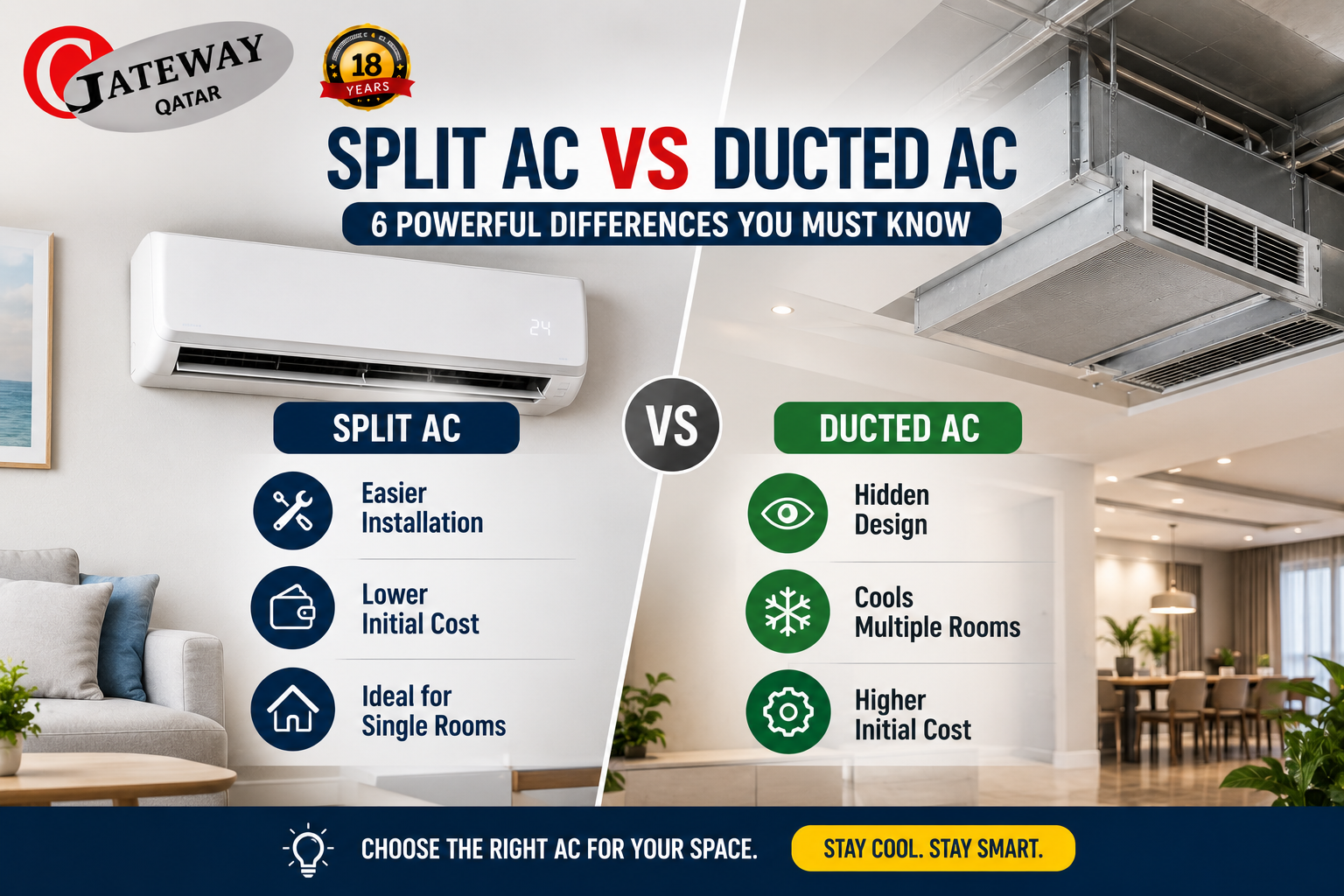
Split AC vs Ducted AC: 6 Powerful Differences You Must Know
The split AC vs ducted AC decision is one of the most common and consequential choices any homeowner, developer, or business owner faces when planning a new air conditioning installation. Both systems cool your property effectively — but they do so in fundamentally different ways, with very different implications for cost, aesthetics, comfort, energy efficiency, installation complexity, and long-term maintenance requirements. Choosing the wrong system for your specific property and usage pattern creates problems that are expensive and disruptive to correct after installation is complete.
The split AC vs ducted AC debate is particularly important in Qatar and the wider Gulf region, where extreme summer heat means your air conditioning system will be one of the most heavily used and financially significant infrastructure investments in your property. Getting the split AC vs ducted AC decision right from the outset protects both your comfort and your long-term electricity costs — while getting it wrong means years of either inadequate performance or unnecessary expense from an overly complex system that your property simply did not need.
Gateway Qatar — an authorised Mitsubishi Electric dealer providing expert AC installation across Doha and the whole of Qatar since 2004 — breaks down the 6 most powerful differences between split AC vs ducted AC so you can make the right choice for your specific property with complete confidence.
Difference 1: Installation Cost — Split AC vs Ducted AC
The first and most immediately visible difference in the split AC vs ducted AC comparison is installation cost. Split AC systems are significantly less expensive to purchase and install than ducted systems of equivalent cooling capacity — making upfront cost one of the most decisive factors in the split AC vs ducted AC evaluation for budget-conscious property owners.
A split AC system requires a wall-mounted indoor unit in each room to be cooled, connected to an outdoor unit by refrigerant pipework and electrical cabling that can be installed quickly with minimal building work. The simplicity of the split AC installation means lower labour costs, minimal disruption to finished spaces, and a faster completion time compared to ducted alternatives.
A ducted AC system requires a concealed air handling unit installed in a ceiling void or plant room, connected to a network of ducts fabricated from insulated sheet metal or flexible duct material that must be routed through ceiling spaces to deliver conditioned air to every room through ceiling diffusers. This additional scope of work — ductwork design, fabrication, and installation — adds significantly to both material and labour costs compared to split AC installation.
In the split AC vs ducted AC cost comparison, ducted systems typically cost 40-70% more to install than equivalent split AC systems for the same property. For property owners where upfront investment is a primary consideration, this cost difference strongly favours split AC in the split AC vs ducted AC evaluation.
For detailed guidance on what professional split AC installation involves and what the installation process looks like in practice, our comprehensive guide on split AC installation in Qatar covers every technical and practical aspect of the split AC option in the split AC vs ducted AC decision.
Difference 2: Aesthetics and Interior Design Impact — Split AC vs Ducted AC
The second powerful difference in the split AC vs ducted AC comparison is the visual impact of each system on your interior design — and for many property owners, particularly in premium villas, luxury apartments, and high-specification commercial spaces, this aesthetic dimension is the single most important factor in the split AC vs ducted AC decision.
Split AC systems require a wall-mounted indoor unit — typically white plastic, 80-100cm wide, and positioned on the wall approximately 20-30cm below the ceiling — in each room to be cooled. In properties with carefully considered interior design, multiple visible wall-mounted units can be visually disruptive, particularly in open-plan living areas, master bedrooms, and formal reception rooms where the unit’s presence is difficult to conceal or incorporate elegantly into the design scheme.
Ducted AC systems are completely invisible inside the building — the air handling unit is hidden in a ceiling void, plant room, or dedicated enclosure, and the only visible elements are discreet ceiling or wall diffusers that can be selected to blend seamlessly with any interior design aesthetic. For premium properties where architectural finish is a priority, the completely invisible installation that ducted AC provides over split AC is frequently the decisive factor in the split AC vs ducted AC comparison.
The split AC vs ducted AC aesthetic difference is particularly relevant in Qatar’s premium villa market, where discerning homeowners increasingly expect the clean, uncluttered interior aesthetic that only ducted air conditioning can deliver. Our comprehensive guide on ducted AC systems in Qatar covers the design considerations and aesthetic benefits of the ducted option in the split AC vs ducted AC decision in detail.
Difference 3: Comfort and Air Distribution — Split AC vs Ducted AC
The third powerful difference in the split AC vs ducted AC comparison is the quality and consistency of comfort and air distribution each system delivers across the property — a dimension that goes beyond simple temperature achievement to encompass humidity control, air freshness, and the evenness of cooling throughout every space.
Split AC systems cool each room independently from a single wall-mounted unit that delivers conditioned air in a relatively direct pattern into the space. This approach works well for individual rooms and small spaces but can create temperature stratification — warmer zones near the floor and cooler zones near the ceiling — in rooms with high ceilings or large floor areas. The independence of each split AC unit also means that different rooms in the same property can end up at significantly different temperatures depending on factors including solar exposure, occupancy, and individual thermostat settings.
Ducted AC systems distribute conditioned air through a designed network of ducts and diffusers that can be carefully positioned to deliver balanced, even airflow to every area of every room simultaneously. A well-designed ducted system eliminates the hot and cold spots associated with single-point split AC delivery, providing more consistent comfort throughout the whole property and better humidity control through centralised air handling and filtration.
In the split AC vs ducted AC comfort comparison, ducted systems consistently deliver superior whole-property comfort uniformity — an advantage that becomes increasingly significant as property size increases and the number of rooms requiring simultaneous cooling grows beyond what multiple independent split AC units can coordinate effectively.
Difference 4: Energy Efficiency — Split AC vs Ducted AC
The fourth powerful difference in the split AC vs ducted AC comparison is energy efficiency — both the rated efficiency of the equipment itself and the real-world electricity consumption that each system delivers across a full year of operation in Qatar’s climate.
At the equipment level, modern high-quality split AC and ducted AC systems from premium manufacturers like Mitsubishi Electric are both available with excellent inverter-driven efficiency ratings. The split AC vs ducted AC efficiency comparison at equipment level is therefore relatively close when both options use modern inverter technology from quality manufacturers.
Where the split AC vs ducted AC efficiency comparison becomes more complex is in real-world operation:
- Split AC efficiency advantage in partial occupancy — when only some rooms in a property are occupied, split AC systems can be operated selectively in only those rooms, consuming no electricity in unoccupied spaces. A ducted system without zone control continues conditioning the entire property regardless of actual occupancy, which can increase real-world electricity consumption compared to selective split AC operation
- Ducted AC efficiency advantage in full occupancy — when the whole property is occupied simultaneously, a properly designed ducted system with zone control can deliver whole-property comfort at lower total electricity consumption than multiple individual split AC units all operating simultaneously at their respective setpoints, due to the efficiency advantage of a single large refrigerant circuit over multiple smaller ones
- Duct heat gain consideration — ducted AC systems in hot climates like Qatar must use well-insulated ductwork to prevent significant heat gain into the conditioned air as it travels through ceiling voids. Poorly insulated ductwork reduces the efficiency advantage of ducted systems in the split AC vs ducted AC comparison
For guidance on how to maximise energy efficiency whichever system you choose in the split AC vs ducted AC decision, our detailed guide on energy efficient air conditioning in Qatar covers every factor that determines real-world AC efficiency in Qatar’s climate.
Difference 5: Maintenance Requirements — Split AC vs Ducted AC
The fifth powerful difference in the split AC vs ducted AC comparison is ongoing maintenance requirements — both the frequency and complexity of professional maintenance that each system type demands to remain operating at peak performance in Qatar’s demanding climate.
Split AC maintenance is relatively straightforward for qualified technicians — each indoor unit is accessible, filters are easily removed and cleaned, coils are exposed and cleanable, and the system’s simplicity means fault diagnosis is typically faster and less complex than for ducted systems. Split AC servicing costs per unit are therefore generally lower than equivalent ducted system servicing costs, though the total split AC maintenance cost across a large property with many units can accumulate significantly.
Ducted AC maintenance requires access to the concealed air handling unit — which may involve working in ceiling voids or plant rooms — cleaning of the central unit’s filters and coils, inspection and cleaning of the duct network, and verification of airflow balance to every supply diffuser. The greater complexity of ducted maintenance typically results in higher per-visit servicing costs compared to split AC, though the single system serving the whole property means fewer individual units to maintain.
In the split AC vs ducted AC maintenance comparison, both systems require professional servicing — the key difference is that ducted system maintenance requires more specialist knowledge and equipment, making the choice of qualified AC service company more important for ducted system owners than for split AC users.
Our comprehensive overview of HVAC maintenance contracts in Qatar covers the maintenance requirements and contract structures applicable to both split AC and ducted systems, providing a complete reference for the ongoing cost dimension of the split AC vs ducted AC decision.
Difference 6: Suitability by Property Type — Split AC vs Ducted AC
The sixth and most practically useful difference in the split AC vs ducted AC comparison is how each system maps to different property types, sizes, and usage contexts — providing a clear guide to which option is most appropriate for your specific situation.
Split AC is generally the better choice when:
- The property is an apartment, small villa, or individual commercial space where the number of rooms requiring cooling is limited and aesthetic flexibility is acceptable
- Budget is a primary consideration and the lower upfront cost of split AC is important
- The property is being retrofitted with air conditioning after construction, where installing ductwork would require significant disruption to existing ceilings and finishes
- Individual room control flexibility is more important than whole-property aesthetic consistency
Ducted AC is generally the better choice when:
- The property is a medium to large villa, luxury residential development, or premium commercial space where interior aesthetics are a priority and the completely invisible installation is desirable
- The property is under construction or undergoing significant renovation where ductwork can be installed during the building phase without disruption to finished surfaces
- Whole-property comfort uniformity is a priority and the superior air distribution of a well-designed ducted system is valued over the room-by-room independence of split AC
- The property owner wants a single, centrally managed system rather than multiple individual units to operate and maintain
According to the American Society of Heating, Refrigerating and Air-Conditioning Engineers (ASHRAE), matching the HVAC system type to the specific characteristics of the building and its usage pattern is one of the most important decisions in achieving both comfort and energy efficiency outcomes — directly confirming that the split AC vs ducted AC decision should be made on property-specific grounds rather than as a generic preference.
For comprehensive guidance on how VRF multi-zone systems compare as a third option in the split AC vs ducted AC evaluation for larger and more sophisticated properties, our detailed overview of VRF system installation in Qatar covers this premium alternative that combines the zone control advantages of split AC with the aesthetic benefits of ducted systems.
Gateway Qatar — Your Expert Guide for Split AC vs Ducted AC in Qatar
Gateway Qatar W.L.L is an authorised Mitsubishi Electric dealer and experienced HVAC contractor providing professional guidance on the split AC vs ducted AC decision — along with expert design, supply, and installation of both system types — for residential, commercial, and industrial clients across Doha and the whole of Qatar since 2004. Our qualified HVAC engineers take the time to understand your specific property, budget, aesthetic priorities, and operational requirements before making an honest, objective recommendation on which option best serves your needs in the split AC vs ducted AC evaluation.
When you choose Gateway Qatar for your AC installation decision, you benefit from:
- ✅ 20+ years guiding split AC vs ducted AC decisions in Qatar
- ✅ Authorised Mitsubishi Electric dealer for both system types
- ✅ Honest, objective advice based on your specific property needs
- ✅ Professional heat load calculation before any recommendation
- ✅ Expert installation for both split AC and ducted systems
- ✅ Comprehensive annual maintenance contracts for all system types
- ✅ Service across Doha and the whole of Qatar
Contact Gateway Qatar for Split AC vs Ducted AC Advice
Not sure whether split AC vs ducted AC is the right choice for your property? Contact Gateway Qatar today for honest, expert guidance and a detailed installation quotation for either system anywhere across Qatar.
📞 Call us: +974 44370415
📞 WhatsApp: +974 55750173
🌐 Visit: Our HVAC Services
📋 Get a Free Quote: Contact us today
📍 Location: Opposite Aspire Park, Mauither, Doha, Qatar
Frequently Asked Questions
Is split AC or ducted AC better for a villa in Qatar?
For most medium to large villas in Qatar where interior aesthetics are important and the property is under construction or undergoing renovation, ducted AC is generally the better choice — delivering whole-property cooling through a completely invisible installation with superior air distribution. For smaller villas or retrofit situations where ductwork installation would be disruptive, split AC provides an excellent, cost-effective alternative. Gateway Qatar provides honest, property-specific guidance on the split AC vs ducted AC decision for every client across Qatar.
How much more expensive is ducted AC compared to split AC?
Ducted AC systems typically cost 40-70% more to install than equivalent split AC systems for the same property, reflecting the additional cost of ductwork design, fabrication, and installation alongside the air handling unit and outdoor condensing equipment. However, the superior aesthetics, comfort uniformity, and whole-property management of a ducted system provide genuine value that justifies the additional investment for many property owners in Qatar’s premium residential market.
Can split AC be upgraded to ducted AC later?
Converting from split AC to ducted AC after construction is complete is technically possible but operationally disruptive and expensive, requiring significant ceiling works to install ductwork in finished spaces. For property owners who prefer ducted AC but have split AC installed, the most practical approach is typically to replace systems one zone at a time during renovation works. Gateway Qatar can advise on the most cost-effective upgrade approach for any specific property
Which system is easier to maintain — split AC or ducted AC?
Split AC systems are generally easier and less expensive to maintain on a per-unit basis, with accessible filters and coils and straightforward fault diagnosis. Ducted systems require more specialist maintenance knowledge and access to concealed air handling units and ductwork, typically resulting in higher per-visit servicing costs. However, a ducted system serves the whole property from a single installation, reducing the number of separate systems requiring maintenance compared to multiple individual split AC units.
Does Gateway Qatar install both split AC and ducted AC systems across Qatar?
Yes — Gateway Qatar designs, supplies, and installs both split AC and ducted AC systems across the whole of Qatar including Doha, Ar-Rayyan, Lusail, West Bay, Al Wakrah, Al Khor, and all surrounding areas. Contact us on +974 44370415 for expert split AC vs ducted AC guidance and a detailed installation quotation for your specific property.